



Consider This:
More information has
never been easier to access …
and yet wisdom has
never felt more elusive.
Why?
God calls us to be good stewards of our thinking. Unfortunately, my experience is that the church in the West—despite the best of intentions—is showing evidence that we don’t understand how to steward our thinking in practice. We often equate “healthy thinking” with having more knowledge, but these are actually vastly different. And as a result, though we have more access to more information than ever before, we demonstrate a lack of wisdom.
This, as we’ll see, isn’t just an extraneous philosophical observation—it reflects a tectonic shift in how we think.
While there are many contributing factors to our situation, the solution is actually pretty simple—once we realize the actual problems. There are two primary dynamics in play:
We don’t understand how we think.
We don’t understand how our brains actually work.
As a reminder, my last article addressed the first issue (and here’s a link to it):

It highlighted a reality few of us recognize: Our brain and our mind are distinct, yet they work together as we live as embodied spiritual beings.
The mind is us. It thinks, believes, chooses and feels.
The brain is the physical organ our mind uses, processing thoughts as electrical impulses across synaptic connections.
The brain (like a car) must respond to the mind’s direction (the driver). But problems arise when our mind allows our brain to drive autonomously. When that happens, we assume “we” are thinking—but we’re really just a passenger.
Understanding this dynamic is essential for grasping what follows: how our brains actually work.
Two Sides to the Brain’s Story
The cerebrum—the largest part of the brain—includes two hemispheres that process thoughts in very different ways. Both are involved in nearly everything we do, but how they participate reflects God’s remarkable design.
Before exploring the differences, we must abandon the old “left- vs right-brained” idea. The notion that some people are “left-brained” (analytical) and others “right-brained” (creative) is an oversimplification that has led to misunderstanding.
We have one brain with two distinct, complementary hemispheres. Each supplies what the other lacks. These differences aren’t theoretical—they shape how we interpret reality, truth and even perceive God.
Here’s a table that shows the differences:
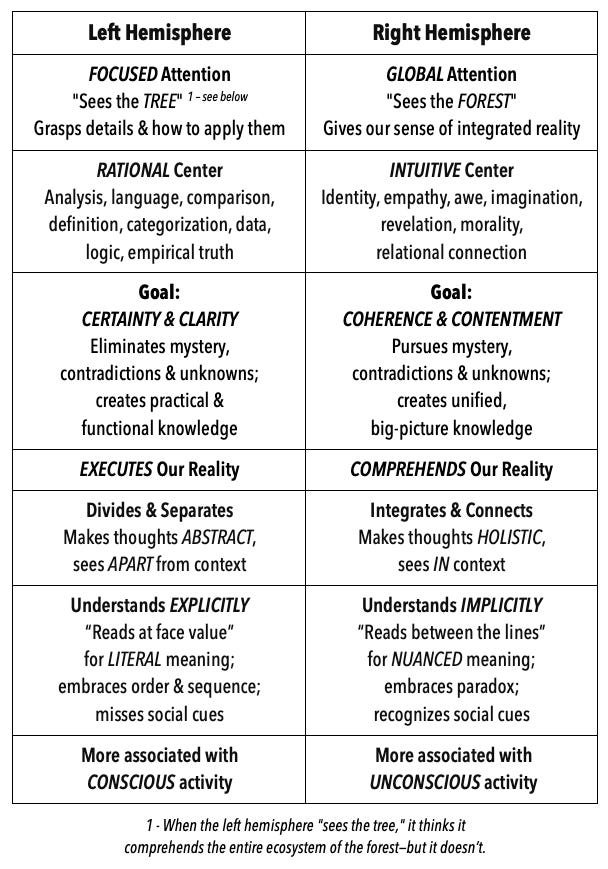
The right hemisphere “sees the forest.” It’s oriented toward big-picture awareness—intuition, connection, meaning, identity, relationship, mystery. It’s goal is achieving coherence and contentment (joy and peace).
The left hemisphere “sees the tree.” It’s oriented toward analysis—rational process, details, language, structure, certainty, execution. It’s goal is achieving clarity and certainty (functional knowledge).
Because the right hemisphere sees the forest, it’s better suited to comprehending reality as a whole, understanding truth in context, experiencing relationship and processing our sense of identity. It’s designed to initiate thinking.
Because the left hemisphere sees the tree, it’s better suited to explicit and detailed knowledge—how things work. It uses words, systems, strategy and actions to do something usable. It’s designed to execute thinking.
Interestingly, the right hemisphere is more associated with unconscious processing to do its work, while the left hemisphere is more associated with conscious processing.
In a healthy pattern, the right hemisphere leads and the left hemisphere serves. But when this order breaks down—especially when the brain begins driving autonomously—some interesting and potentially damaging patterns can develop.
1) We Can Become Unteachable
When the left hemisphere dominates, it prioritizes certainty over coherence, and what’s consciously known over what’s unconsciously being revealed. It narrows focus.
It is naturally skeptical, mistrusting ambiguity and anything that can’t be proven. It becomes confident—sometimes overconfident—in its conclusions. When that happens, learning shuts down … not because there’s nothing left to learn, but because we think we already know.
This doesn’t make the left hemisphere wrong—it makes it incomplete when operating alone.
Connecting this to repentance and renewal, it becomes clear why left-hemisphere priority is insufficient for developing the mind of Christ. The left hemisphere isn’t naturally inclined toward change or growth, especially when it involves stepping beyond what is already known.
It isn’t comfortable taking leaps of faith on its own.
Yet repentance and renewal require openness—a willingness to reconsider what feels settled. Without this, the left hemisphere retreats into the castle of self-protection, confidently defending what it already knows.
It becomes unteachable.
2) We Can Become Unwise
Being unteachable makes knowledge dangerous, because it’s easy to mistake rational knowledge for intuitive wisdom. Wisdom isn’t accumulated knowledge, it’s integrated knowledge. Wisdom leverages existing knowledge in new and varied contexts.
Wisdom emerges when left-hemisphere knowledge is reintegrated—deepened through reflection and connection. It enables us to navigate new paths with confidence (almost as if we’ve been there before).
But when thinking remains confined to rational analysis and information, it never matures. It stays abstracted from our reality, identity and experience with God. We accumulate information, refine arguments and pursue precision, yet fail to become wise.
And without wisdom, our thinking becomes fragmented—accurate in parts, but disconnected as a whole.
3) We Stay Unrenewed
Here’s where it becomes more personal.
There are thoughts in your brain—about life, God, yourself and others—that were formed long ago. Some came from experiences, others from wounds or teaching.
Many remain unexamined. They operate 24/7 beneath your awareness, shaping how you interpret everything. If they’re never brought into the light, they continue to drive your life—without you realizing it.
They seem normal, and even trustworthy. Yet they may be false, dysfunctional and perhaps even destructive.
Seeing repentance as a one-time event won’t renew them. Practicing repentance as sorrow or regret won’t renew them. Experiencing and expressing emotion alone won’t renew underlying thoughts and beliefs.
4) We Lean On Our Own Understanding
Eventually, all of this converges into a single unhealthy thinking posture: Self-reliance.
We rely on what makes sense to us—what feels certain. We trust in what aligns with our existing framework. Without realizing it, we filter everything—including God—through that lens.
Our thinking becomes calloused to the Spirit. Our hearts harden as we’re pulled into the gravity of self-reliance and autonomy.
This isn’t obvious, intentional rebellion. It’s quieter and more subtle. We intend to be faithful, but we redefine faithfulness—from responsive trust to religious adherence. We self-protect and control as a way of life.
Even as we give our allegiance to God.
We’re still thinking, believing and acting—but now we do so within a system we unconsciously chose and yet would consciously deny.
And this also happens to be a cultural issue for the world in which we live.
This fourth pattern is the most concerning, and is where we must turn next.
State of Mind
Here’s my proposition: The church in the West has entered a phase where thinking has shifted predominantly to the left hemisphere.
I’ll develop this in future articles. For now, understand that this shift has unfolded gradually over centuries, largely unnoticed. We’re now seeing the effects in both thinking and behavior—which is where I will go in my next article.
But for now, I ask you to reflect on the state of your mind. Consider these questions, for example ...
Which seems more “real,” tangible and trustworthy:
Theological constructs, opinions of Christian thought leaders, Bible resources, creeds and traditions
orThe voice and fellowship of the Holy Spirit?
When you hear “church,” what comes to mind first:
An organization that sponsors weekly spiritual activities and affirms your personal doctrinal positions
orThe collective of those who’ve followed God across history?
Which better describes the meaning of “abiding”:
Practicing spiritual disciplines and personal devotions
orLiving as a branch that’s dependent on the Vine?
When you hear “identity in Christ,” do you think of:
Your forgiveness and justification through the cross
orBeing a living and personal expression of Jesus?
What resonates most when you hear “be sanctified”:
Working toward holiness to please God
orRemaining in your state of declared holiness?
What defines “leadership”:
Exercising power and positional authority in a hierarchy
orInfluencing through serving others?
The degree to which you struggled to choose the second bullet on each question is an indication of just how left-hemispherical we’ve become in our thinking preference. All this discussion about the mind and the brain, the brain’s two hemispheres ... it isn’t philosophical intellectualizing. It’s practical, tangible—even existential.
There’s more to explore, and it’s easy to get lost in the details. But I’ll close with a paraphrase of God’s consistent instruction from the Bible about thinking well—using both hemispheres in alignment.
Notice the pattern: One thought establishes context, the other executes. One grounds in truth, the other uses that truth to move to action.
Contemplate it—and ask God to show you how to think more effectively.
“Trust in the Lord
with all your mind, will and devotion.
Do not lean on your own understanding.
In all your ways,
know him deeply and experientially
and submit everything to him fully,
and he will direct you on right paths.
Do not lean on your own knowledge
as a foundation for wisdom.
Instead, know and respect the Lord.
Then put that wisdom into practice
by avoiding evil.”
(see Proverbs 3.5-7)
Peace be with you ...

I love the 2-option questions at the end! They provide a practical way to assess how the way we think impacts our worldview, beliefs, and relationship with God.