


Consider This:
How should we expect to hear God
using the same thinking habits the world does?
This is a wrap-up of a 3-part series on how God designed us to think so that (among other things) we can hear him more effectively.
Perhaps the biggest barrier
to hearing God is assuming that
our minds are prepared to hear him.
We should consider that, most likely, they aren’t. There’s a lot of transformation required to perceive him truthfully and receive what he’s saying to us.
Unfortunately, much of the church in the West hasn’t been relating to God in the same way he’s relating to us. We’ve centered our faith practices on WHAT we should think— ignoring the far more important discipline: HOW we should think.
That’s what this three-part article addresses.
In Part 1 of How God Designed Us to Think, I introduced four aspects of thinking:
2 Realms — The Mind (the spiritual realm) and the Brain (the physical realm).
2 Domains — The Rational (largely served by our brains’ left hemisphere) and the Intuitive (served by the right).
3 Phases — Distinct perspectives of thinking both rationally and intuitively.
1 Flow — An integrated thought process that partners with the Holy Spirit.
Part 1 unpacked the 2 Realms and the 2 Domains, and Part 2 covered the 3 Phases. This article rolls everything up into the 1 Flow.
Here are the links to Part 1 and Part 2 …


1 Flow of Thought
This flow is the aggregation of thinking in …
The 2 Realms — The spiritual and the physical
The 2 Domains — The intuitive and the rational
The 3 Phases — The integrated movements of 1) Reflecting, 2) Recognizing-Receiving-Responding, and 3) Reintegrating.
As these ways of thinking become integrated, they operate as a single flow—a kind of operating system for how we experience and process reality.
This isn’t a methodology,
it’s a way to experience living.
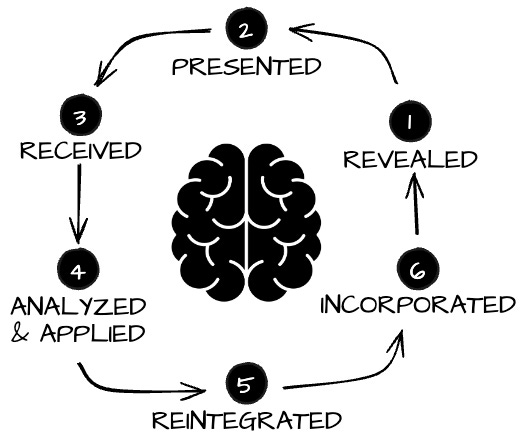
The Flow describes the phenomenon of experiencing truth and understanding—what happens in our mind and brain as we interact with God. In other words, it’s what we sense, how we sense it, how we interpret meaning and how it impacts our perception of reality.
This is God’s design for our brains to experience ongoing renewal that transforms us spiritually. The flow moves cyclically, from …
… a surrendered and dependent identity, to ➔ a trusting and open posture, to ➔ awareness of new insights, to ➔ conscious contemplation and consideration, to ➔ deliberate application and obedience, to ➔ the pursuit of wisdom, to ➔ ongoing reshaping of our perception of reality, to ➔ the next stage of forming our dependent identity that looks like Jesus.
Here’s a summary of how we experience the flow as thoughts are …
REVEALED. Thoughts and new revelation come into our mind—most of which will be initially unconscious to us at first. So revealed here doesn't mean consciously recognized. Many things enter our mind and begin affecting us before we consciously perceive it.
PRESENTED. Thoughts and new revelation move from unconscious to conscious awareness. They’re usually intuitive and not well-structured, and will challenge our current understanding. We often struggle to find language to sufficiently describe them.
RECEIVED. The new thoughts get viewed through the lens of our existing paradigms and knowledge. If we dismiss them or tag them as already known, the flow stops. So receiving new thoughts is intentional engagement, training ourselves to be sensitive and receptive.
ANALYZED and APPLIED. We begin analyzing the new thoughts and how they fit (or don’t fit) into our current understanding. Language gets applied as we describe them and determine how to apply them. At this point, we “apprehend” the new thoughts (including recognizing there’s more we don’t know).
REINTEGRATED. We now have two alternatives:
1) View our new knowledge as finished and complete, or
2) Remain curious and open, seeing it as a seed that will bear deeper understanding.
The second choice releases analyzed knowledge to the larger field of experience.INCORPORATED. The new knowledge is infused into the broader context of our life with God and perception of reality, which is how we develop wisdom. Though much of this occurs at the unconscious level, it spawns new insights and the flow continues.
Because the last two parts involve unconscious processing, Westerners tend to dismiss them as nebulous, ethereal and impractical.
But it’s actually where
the heavy lifting of
renewing our mind occurs.
So we must be intentional about shaping and renewing our unconscious thinking. This will be a step of faith for Western believers, who are accustomed to trusting conscious thoughts that are concrete, certain and “visible.”1
This involves faith. After all, we’re partnering with the Spirit in unconscious thought processes we cannot “see.” This is “being sure of what we hope for, being convinced of what we do not see” (Heb. 11.1 NET).
Why the 1 Flow Matters
This flow is how we come to “know” and “understand” spiritual truth for what it is.2
It is how we come to
know and experience God
—and the fullness of the gospel—
the way he intends.
Interestingly, there is a wide spectrum of Greek words used in the Bible to describe the act of “knowing” and “understanding.”3 Two of them are eidō and ginōskō, whose meanings reveal very different shades of knowing.
Eidō — “Knowing by observation”—clear mental perception. This is part of apprehending: explicit, rational knowledge that’s been intellectually grasped and recognized. We see it in John 13.1, where Jesus “knew” (eidō) that the hour had come for him to be crucified. Today we might ask, “Do you see what I mean?”
Ginōskō — “Knowing by participation”—full, contextualized understanding gained through encounter and experience. This is part of comprehending: implicit, intuitive understanding that often defies description. We see it in Philippians 3.7-11, where Paul wanted to “know” (ginōskō) Jesus and experience Jesus’ death and resurrection for himself. Today we might ask, “Do you feel me?”
We need both eidō and ginōskō. Both are healthy, complementary and necessary. But without this flow, our experience of knowing at both levels will be severely limited.
Thinking Correctly in the 1 Flow
Expanding this more, watch some of the ways Scripture describes knowing and understanding in relation to the flow.
REVEALED — “He made known to us the mystery of his will” (Eph. 1.9). “Made known” = gnōrizō: “to certify or declare,” and “to disclose.” As a form of ginōskō, it carries the same experiential knowledge connotations.
PRESENTED — “I pray that the eyes of your heart may be enlightened” (Eph. 1.18). “Enlightened” = phōtizō: “to bring to light, to render evident.” Enlightening causes something to exist in our consciousness that wasn’t previously there (e.g. “the light bulb came on”).
RECEIVED — "I pray … that you may … grasp how wide and long and high and deep is the love of Christ" (Eph. 3.17-18). “Grasp” = katalambanō: “to lay hold of.” It is grasping thoughts concretely so that they become useful (e.g. “I get what you’re saying,” “Do you get it?”).
ANALYZED & APPLIED — “But whatever were gains to me I now consider loss for the sake of Christ” (Phil. 3.7). “Consider” = hēgeomai: judgments, decisions or evaluations resulting from analysis and consideration of available facts.4
REINTEGRATED — “By faith we understand that the universe was formed at God’s command” (Heb. 11.3). “Understand” = noeō: “to direct one’s mind toward; to think upon, heed, ponder or consider.” It’s using a known idea to explore for more understanding and imagination.
INCORPORATED — “Then he opened their minds so they could understand the Scriptures" (Lk. 24.45). “Understand” = syniemi: literally, “to send together.” It’s the outcome of the reintegration process, fusing understanding into our broader comprehension. It produces coherence, like the concepts of synthesizing or “connecting the dots.”
The point with all this is simple: Knowing God is far more than acknowledging information about him. The more we learn to know him experientially and intimately, the more we will be able to abide in Christ.
Context for God’s Thinking Design
As a thought exercise, take a season and objectively observe what you see in the world: what it’s talking about, and how it’s talking about it. Then—working from the assumption that our doing is the outcome of our thinking—look deeper into the world’s priorities and behaviors:
What does it aspire to be?
What does it consider to be “real?”
What brings coherence to life?
How does it describe love, peace and joy—and how to get them?
Then ask yourself, “What kind of thinking process would produce what I see?”
SPOILER ALERT: It won’t resemble the flow described above.
A Christianized conclusion would judge that the world doesn’t think with the God-designed flow because it doesn’t have Jesus.
Technically, that’s not wrong. But there’s a far more profound reality to consider: To a large degree,
the world doesn’t have Jesus
because it doesn’t think
with the God-designed flow.
And herein lies our greatest danger.
We would do well to recognize how deeply the church in the West has adopted Western secular thinking processes, Christianizing and repurposing them for our modern religious practices. It’s happened gradually, over many centuries … so it’s not surprising that we haven’t noticed.
But it’s time we notice. And repent.
The Greek word for “repent” is metanoeō, a combination of meta and noeō—the same noeō we saw above in 5. REINTEGRATED. Repentance involves a changed mind, a changed perception—a fundamentally different way of seeing.
The world’s way of thinking won’t lead us to the kingdom or to deeper, abiding faith in God. It won’t bring peace. We won’t experience the joy from God being in us and us being in him.
It will only increase our spiritual blindness.
What version of Jesus will we then have to offer the world? What will our disciple-making become?
Selah.
I am praying for you. Peace be with you …

Agree? Disagree?
I’m eager to know your thoughts and
kick this content around with you.
Leave a comment or message me to discuss.
Follow2Lead is a reader-supported
publication. You can subscribe for free
to receive new posts. But please consider
becoming a paid subscriber to receive
additional insights and to support
my service to the church. Thanks!
Footnotes:
We shouldn’t be leery or skeptical of having unconscious thoughts. After all, most of the brain’s processing occurs unconsciously—some sources estimating that between 95%-99.5% of all brain activity is inaccessible to our conscious awareness. The point is, the overwhelming majority of the thoughts driving our life and faith practice happen outside our conscious thinking.
Thinking with this flow is how we comprehend what it means to be “free indeed” (John 8.32, 36); it’s how we “worship the Father in Spirit and in truth” (John 4.21-24).
The Greek language often uses multiple words to express a depth of meaning that often gets “flattened” in English. For example, so far I have identified 59 unique Greek words that describe different aspects of knowing, understanding, learning and comprehending.
Interestingly, hēgeomai also means “to lead”—i.e. being a leader or being first. When applied to thinking, the idea is that when we make a judgment or decision, that takes the lead on all other possible alternatives.
Thanks Damian! This is insightful. But I'm not sure I grasp how this works in real life. Could you provide an example or two in a future article? Maybe some guidance on the time frame in which this takes place? Could you provide any tools or exercises that would help us to put our minds in a state of openness to the more intuitive steps and help in the processing of the more logical steps?