


Consider This:
Some of the most important thoughts
you need to hear
are the ones you don’t realize
you’re ignoring.
I’m currently in a series of articles dealing with the topic of hearing God. It’s easy to assume that we hear God with thinking processes that are neutrally calibrated and receptive to him.
But unfortunately, that’s very much NOT the case.
There are numerous ways our thinking habits have become misaligned with the ways God relates to us. So we must become good stewards of our thinking processes. We need a practical, big-picture perspective not on WHAT we think, but HOW we think.
In Part 1 of How God Designed Us to Think, I introduced four aspects of thinking that we can manage more effectively. They are:
2 Realms — The Mind (the spiritual realm) and the Brain (the physical realm).
2 Domains — The Rational (largely served by our brains’ left hemisphere) and the Intuitive (served by the right).
3 Phases — Distinct perspectives on thoughts in the 2 Domains.
1 Flow — A seamless and integrated practice that partners with the Holy Spirit.
Here’s the link to Part 1 if you want to refresh …

Part 1 unpacked the 2 Realms and the 2 Domains. In this article, I’ll cover the 3 Phases, and the next article will put everything together in describing 1 Flow.
Also, a point I made in Part 1 bears repeating: Avoid the temptation to oversimplify this. Current thinking habits in the West look at 2 Realms + 2 Domains + 3 Phases + 1 Flow as a way to deconstruct human thinking into its irreducible components.
Human thought processes are dynamic, complex and uniquely personal to each of us. So it’s important that this 2+2+3+1 be viewed as a way to
see general patterns and principles
in the beautifully integrated
and complex whole
that is our human existence.
Agreed?
Okay, let’s get into the next pattern …
3 PHASES of Thinking
These aren't three different kinds of thinking so much as three movements within an integrated thinking process. The combination of the 3 Phases is a purposeful approach that leverages our brain’s hemispheres (i.e. the 2 Domains from Part 1) to intentionally invite God into our thinking to produce deeper understanding and wisdom.
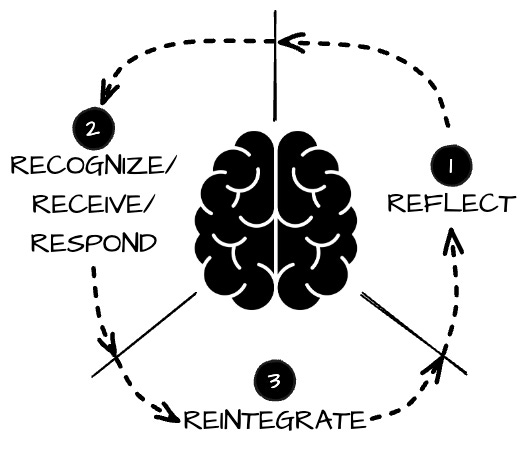
Each phase is highly dependent on the other two. Meaning:
The synergy of all three
working in combination
dramatically impacts our overall
comprehension and understanding.
They help ensure our thought processes are integrated, holistic and coherent.
1 - Reflect
I see reflection as “assessing without evaluating.” It asks, “What do I notice?” The goal is extended and impartial observation—not judgment or evaluation. It creates space for things our normal analytical thinking may overlook. It lets you notice your thoughts rather than be driven by them.
It intentionally gives more of the microphone to the right hemisphere, allowing it to speak to what it’s been paying attention to. The right hemisphere is particularly attuned to the broad perspective and deeper, more connected insights, so it can expose thoughts worthy of deeper exploration.
2 - Recognize-Receive-Respond
Reflection “presents” right-hemisphere thoughts to the left hemisphere. But they don’t arrive as organized, ready-to-use packages of information. Instead, they could be any combination of things like …
Emotions (fear, peace, judgment, jealousy, longings, etc.).
Memories.
Out-of-the-blue ideas.
Images.
Motivations.
Bible verses.
Conscience-related thoughts (having a moral component).
Accusations (“what a stupid idea,” “you’re all alone”).
Affirmations (“you’re my child,” “I know you”).
This phase is itself a three-step sequence:
Recognize. “This thought/emotion/image is present.”
Receive. “I will allow it to remain present rather than immediately dismissing, suppressing or judging it.”
Respond. “I will evaluate what it means and what, if anything, I should do with it.”
This three-step sequence interrupts the left hemisphere’s natural, impulsive tendency to …
Ignore the thoughts from the right hemisphere, and
Dismiss them as distracting, insignificant or without value.
These steps allow the left hemisphere to do what it does best: Evaluate, organize and describe the thought and consider how to apply it.
3 - Reintegrate
In my opinion, the last phase is the most important for believers in a Western context.
It’s a lost skill.
As a society, we’ve largely
forgotten how to do it.
Reintegration is the intentional, left-hemispherical step of releasing a thought back into the right hemisphere for more orientation and context. This is where the previous illustration of the forest and the tree makes sense…
The right hemisphere “sees the forest” of our reality, and the left hemisphere “sees the tree.” Reintegration takes the knowledge gained from analyzing the tree, and puts it back into the forest. This allows the right hemisphere to leverage this new information to further comprehend the forest.
Practically, this might look something like this:
A person reflects and notices anxiety about an upcoming decision → recognizes and analyzes the fear → realizes it is connected to an unhealthy desire for control → then reintegrates that insight into their exploration of their identity, relationship with God and what God may be exposing.
Reintegration is a vital step, because on its own the left hemisphere tends to “stand pat” with its current knowledge. It must be trained to stay humble, curious and hungry to learn.1
Follow2Lead is a reader-supported
publication. You can subscribe for free
to receive new posts. But please consider
becoming a paid subscriber to receive
additional insights and to support
›my service to the church. Thanks!
Why the 3 Phases Matter
As a reminder, the right hemisphere pays global attention and is more in tune with our unconscious thoughts than the left. So (using the car and driver metaphor from the Part 1 article),
NOT using the 3 Phases means that
our left hemisphere is
driving most of our thoughts,
while the right hemisphere
sits in a parking lot.
For more details on the differences between the hemispheres, read the section Two Sides to the Brain’s Story in this article …

This has some significant consequences:
We don’t develop wisdom. The left hemisphere is prone to both over-prioritize what it knows and to under-estimate what it doesn’t know. While it’s fantastic at rational data and information, that knowledge has much less value when we don’t know how it all fits together in a coherent whole.
We struggle to hear God. Part of the reason we don’t hear God is that we simply don’t allow space in our thinking to allow him to speak. I believe the right hemisphere is particularly important in our receptivity to spiritual truth, revelation and interaction with the Holy Spirit.2
We over-prioritize strategy, activity and achievement. We live from a productivity orientation to life. We have clarity about what we should DO, but who we should BE remains vague and elusive.
We detach from emotions—particularly fear. We avoid processing fear-based thoughts, using coping mechanisms to stuff, explain away or deflect them for fear of what we might discover.
We live from our old, independent identity. When not integrated with the right hemisphere, the left hemisphere prioritizes certainty and control. This eventually drives us toward a posture of independence from God.
Thinking Correctly in the 3 Phases
The How-To’s
Pick Your Time. Set aside intentional, daily time for reflecting. Pick a time you can practice consistently (ex: end of day), where you’re undistracted, not multitasking and are fresh enough to think clearly.
10 minutes is often sufficient (as long as you do it every day). It’s actually more effective to do shorter times of reflection multiple times per day.
Keep the Goal in Mind. The goal is to pull yourself out of your usual thinking habits to be still and present with God. It may feel awkward or forced in the beginning—so don’t be discouraged.
It’s not a race, or a performance. It’s about gradually learning a new habit. Your physical brain needs the time to develop the neural network to support your new thought habits.
Make it Yours. If you want to journal your reflections, go for it. If that would distract you, then don’t. Light candles. Go on a walk. Sit quietly or listen to meditative music. Whatever you choose to do (or not do), let it fit you and your needs.
It’s not about a method—
which will morph over time anyway.
Don’t Rush the Middle. When something surfaces consciously in Phase 2, resist the impulse to immediately explain, judge or act on it. First recognize that it's there. Receive it without assuming it's true. Then respond by exploring where it came from, whether it aligns with truth and what it might be revealing.
Reintegrate with Questions. When you get to Phase 3, ask God open-ended questions, like: “What do I need to understand about this?” “What does this impact?” or “How’s this different from what I understood before?” Let the Holy Spirit instruct you and reveal things to your mind.
If you’re a fan of Jamie and Donna Winship’s teaching, you’ll recognize their two recommended questions that stimulate Reintegration: “What do you want me to know?” and “What do you want me to do?”
The Watch-Fors
You’ll probably become aware of thoughts you may not have noticed before. Don’t assume that everything you notice is from God. The enemy can also exploit this space, and some thoughts simply arise from our own beliefs, memories and habitual patterns.
You’ll also probably notice fear-based thoughts (“Take control of this situation,” “You’re going to run out of money,” “Protect your reputation,” etc.). This is absolutely, 100% normal.
While that may sound depressing, the thoughts you’re now noticing have always been there, influencing your behavior and decisions … you just didn’t know it.
Now, you are putting yourself in position to manage them, “taking every thought captive and making it obedient to Christ” (2 Cor. 10.5 NASB). After all,
You can’t take any thought captive
and make it obedient to Christ
if you don’t know it exists.
Neglecting these movements will make our thinking, to some degree, futile. It will be far more difficult to differentiate wisdom from folly, right from wrong and the voice of the Spirit from the voice of the enemy.
Eventually, through practice, the whole 3 Phase process becomes organic. You won’t have to schedule time for it. It becomes integrated into your normal thinking pattern, where it’s actively operating in your mind as you move throughout the day.
In other words, your thinking takes on the 1 Flow that I’ll describe in the next article.
Peace be with you …
Agree? Disagree?
I’m eager to know your thoughts and
kick this content around with you.
Leave a comment or message me to discuss.
Footnotes
The left hemisphere can function a bit like an overconfident and presumptuous 17-year old: It’s capable and has a lot to offer, but if it’s not managed well it thinks it’s already learned all it needs to know.
This would take more time and space to lay out my explanation for why I think this is true. But, in my opinion, there’s enough evidence to point to the proposition that the right hemisphere is essential for the kind of interaction with the Holy Spirit that we see in 1 Cor. 2, where the Spirit reveals spiritual truth to our natural mind. It’s a fascinating area of thought.
This is such a powerful reminder that spiritual reflection is not about performance, but about creating space to hear, discern, and respond to God. I especially appreciate the reminder that we cannot take a thought captive if we never recognize that it exists.
“We take captive every thought to make it obedient to Christ.” — 2 Corinthians 10:5
May the Holy Spirit continually renew our minds, help us discern what is from God, and give us wisdom to reject fear, lies, and unhealthy patterns. “Be transformed by the renewing of your mind.” — Romans 12:2
Thank you for sharing this. May we learn not only to slow down, but to become more attentive to God’s voice and obedient to what He reveals.