

How God Designed Us to Think (Part 1)
Thinking That Aligns with Hearing God


Consider This:
We spend a lot of time focusing on
WHAT we think.
It’s time we focus on
HOW we think.
When it comes to thinking, the Bible has one overarching meta-message:
We are called to be
good stewards of our thinking.
Stewarding our thinking isn’t just managing what we think, it’s managing how we think. Thinking only good thoughts or learning more information about God isn’t helpful if we’re relying on unhealthy approaches to process it all.
Stewarding our thinking is about understanding the things that shape our perception of God, ourselves and the reality we live in. It’s about practicing the disciplines that allow for wisdom to take root and flourish.
We are called to think the way God thinks—having the mind of Christ—so that we can relate to God the way he relates to us.
The Impact of Not Stewarding
If we don’t steward our thinking well, we set ourselves up for frustration and anxiety. Poor thinking habits interfere with hearing God.
For example, think of Jesus’ teaching not to worry (Mt. 6.25-34). Jesus made it a command because worry reinforces a false belief about God. Specifically, that God is unwilling and/or unable to provide for our needs.
But how can we eliminate worry if we approach it as a task to complete—without addressing the thinking that actually created the worry?
How should we expect to hear God if we actively hold on to a way of thinking that believes he’s not who he claims to be? How will this damage our experience of faith if it’s never addressed?1
Uncorrected, bad thinking habits
can literally shape our physical brain
making it hard to hear God effectively—
even when our hearts WANT to hear him.
We’re not relating to him the way he’s relating to us.
2 Realms + 2 Domains + 3 Phases + 1 Flow
As the heading above indicates, I will walk through four aspects of managing our thinking. But before doing so, we need to be conscious of a very real risk:
It’s easy to oversimplify the process,
and potentially do more harm than good.
Human thought processes are incredibly diverse, intimate, multifaceted and organically unique to each of us. Contrary to what the heading might imply, our thinking is NOT reducible to a formula that works mechanically, predictably the same way, every time, for every single person.
Trying to comprehend thinking by breaking it into its constituent parts can easily lose sight of the integrated whole. So instead, let’s see how the parts operate within the coherent context of human existence “in God”—and him “in us.” 2+2+3+1 are macro-patterns that allow us to appreciate, with awe and wonder, how God created us to commune with him.
This article will be a fly-over of the first two (2 Realms and 2 Domains), and the next article will cover the last two (3 Phases and 1 Flow).
2 REALMS of Thinking
We are embodied spiritual beings, harmoniously living in two realms simultaneously: the physical and the spiritual. Applying this in the context of thought activity reveals two areas of focus:
The MIND — The thoughts in your mind are the part of your spirit/soul, the immaterial part of you that is a conscious and sentient being that is intimately connected to but distinct from your physical body.2
The BRAIN — The thoughts in your brain exist as physical energy: electrical impulses stored and transmitted across the cells and synapses of your brain.
It’s impossible to know, of course, where one realm stops and the other starts. But we don’t need to know that to manage them well. What’s most important for us to know is that both require renewal for our spiritual transformation to occur (Rom. 12.1-2).
So we must steward both intentionally.
Why The 2 Realms Matter
I find it helpful to understand the interaction of the brain and the mind by picturing the brain as a car, and the mind as the driver. This, of course, is a metaphor (remember my caution about over-simplifying above). But it reveals a significant principle that’s necessary for our spiritual formation:
As the driver, the mind decides where to go and how to get there.
As the car, the brain responds to and activates the mind’s inputs.
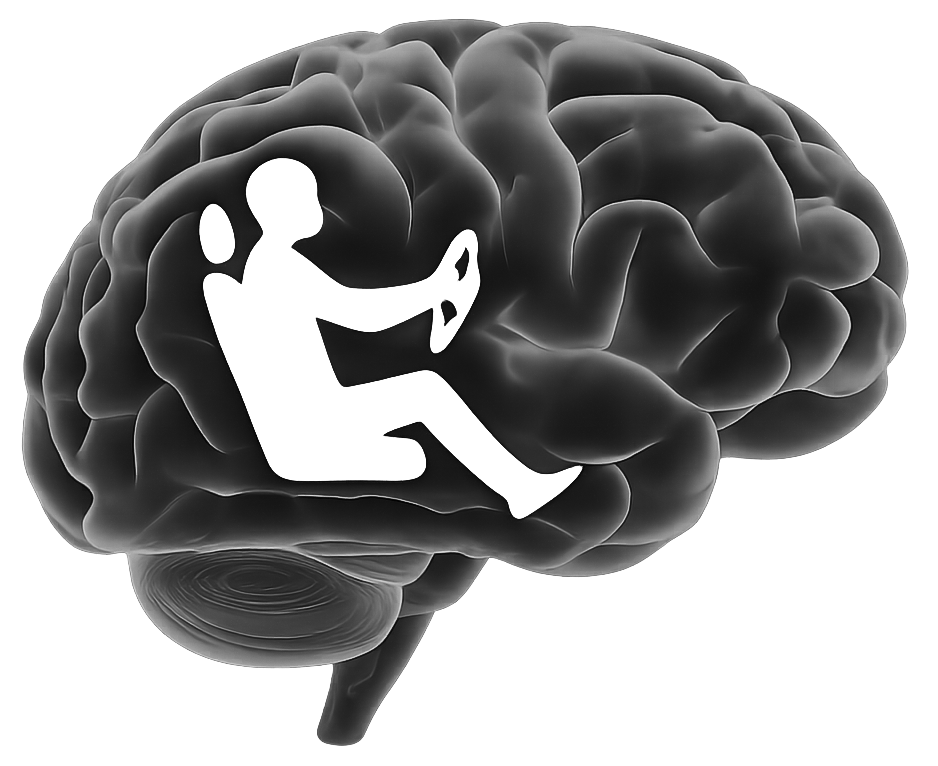
The problem comes in that it’s easy for the mind to allow the brain to drive autonomously.
When the mind allows the brain to drive,
the mind becomes a passenger—
“along for the ride”
to wherever the car is going.
When parts of the physical brain hold on to unrenewed thoughts, the brain resists driving toward the new ways of thinking God invites us into:
“Love your enemies.”
“Consider it pure joy when you encounter trials.”
“When you are weak, then you are strong.”
“You are my masterpiece, and I’m so pleased with you.”
Our brains have been traveling those opposing pathways all our lives, so the old roads are broad, familiar and easy to follow. Our brain needs to be trained to think differently.
This training involves a process called neuroplasticity—the brain's capacity to physically reorganize itself by strengthening, weakening and developing neural connections in response to repeated experience and thought. I’ll talk about this more in future articles, but the main point is this:
Our brains will not develop
unless our minds engage as the driver.
Thinking Correctly in the 2 Realms
Mostly, this comes down to three principles:
Know that your mind is more than a passenger to your brain’s thoughts.
Your mind can drive changes in your physical brain. This will require constant attention and continual repetition of thought—along with the belief that the changes will come—but your brain will eventually conform.3Just because you have a thought in your brain doesn’t make it legitimate or true.
Remember worry? Thoughts of worry and anxiety seem natural … but they’re based in fear, not in truth. They may feel familiar, but just because we practice them all the time doesn’t mean they’re reliable.Neuroplastic development comes through repeated, habitual use of the new thought.
It’s not enough to think the new thought one time, or to simply acknowledge a thought as true. It requires consistent, focused thinking that then becomes a lifelong habit we leverage daily until we see Jesus face-to-face.
2 DOMAINS of Thinking
In addition to thinking in 2 realms, there are two different ways to attend to the things we perceive, know and experience:
Rational Processing — This is explicit, tangible, abstract (i.e. it’s understood apart from a specific context) and typically conscious. Math, for instance, largely utilizes rational processing, as does most of our language function.
Intuitive Processing — This is implicit, intangible and is usually highly connected to a context. We might be consciously aware of some intuitive processing, but most of it is unconscious. Typical practices include having “gut” feelings, empathy, emotions, reading body language, comprehending metaphor, paradox, sarcasm and narrative/story.
Importantly, both domains are legitimate and viable—neither is more important than the other. Both domains require renewal for our transformation, so we must be intentional about stewarding both domains.
Generally speaking, these two domains correspond to different emphases in our brain’s hemispheres:
The right hemisphere tends toward processes that support intuition.
The left hemisphere leverages processes that support rational thinking.
Both hemispheres are involved in virtually everything we do. So the old perception of someone being either “right-brained/creative” or “left-brained/logical” is almost entirely useless. This concept should be thrown as far downwind as possible.
We have one brain, and both hemispheres of our brain are designed to work together harmoniously and interdependently—even though in many ways they are opposites of each other.
The problems come when
we don’t use them in
the way God designed them.
Why The 2 Domains Matter
In the West, we are now over-reliant on the rational (left-hemisphere) domain, while simultaneously overly-suspicious of the intuitive (right-hemisphere) domain.
We’ve become captivated by the clarity and certainty that the rational domain provides. It’s easier and feels more “real.” As a result, we simply don’t know how to recognize—much less utilize—the intuitive domain. We’ve trained our brains to drive autonomously using our left hemispheres.
We’ve lost the competency of integrated thinking.
We’ve lost our minds.
And now we can’t relate to God the way he’s relating to us.
Thinking Correctly in the 2 Domains
This may be the most challenging part of changing our thought habits, because virtually everything else in our experience reinforces a rational, left-hemispherical way of thinking.
The next article (covering the 3 Phases and 1 Flow) will provide more structure. But for now, the biggest hurdle involves belief—we simply don’t believe that intuitive processing is legitimate and trustworthy.4
So the first step is simply this: Notice.
What do you recognize in your thinking? What patterns consistently show up?
That random thought that just shot across the bow of your thinking … what was it?
What emotion are you feeling at the moment (don’t react to it, just notice it)?
What’s your gut telling you (again: don’t act on it, but what’s it telling you)?
What might this person be trying to say, though their word-choice is poor?
How is fear motivating my thinking right now?
What images, memories, stories or people are coming to mind?
Engaging in thoughts like this might seem … distracting. You might be thinking, “I don’t have time or energy to think about all this!” But actually, all this processing is already happening—you’re just not consciously aware of it.
The opportunity comes in noticing it. You may want to take 5-minute breaks from your activity (like the end of the day or at lunch) to give yourself the space to notice. The content in the next article will provide you a way to process it effectively. Eventually, you’ll learn how to integrate it seamlessly and effortlessly into your thinking.
Relating to God
The next article will show how to practically apply the 2 Realms and 2 Domains. So for now, don’t try to fix what you notice.
Just notice.
Pay attention to the thoughts, emotions, images, instincts and reactions already moving through you.
Learning to steward our thinking begins by becoming aware of how we’re already thinking so we can bring it into conformity to Christ. Some will involve correction; some will involve deepening. It will all get sorted out and aligned in due time.
Because the goal isn’t simply to think better. It’s to become increasingly capable of relating to God in the same way he’s relating to us.
Peace be with you …

Agree? Disagree?
I’m eager to know your thoughts and
kick this content around with you.
Leave a comment or message me to discuss.
Footnotes:
This is actually more drastic and dangerous than it sounds. On the one hand, we affirm our theology that acknowledges God as sovereign and capable of meeting our needs. But on the other hand, we actually don’t trust him. So we believe CONSCIOUSLY and RATIONALLY that God is the true God, while UNCONSCIOUSLY and INTUITIVELY believing the opposite. So we live “double-minded” (Jas. 1.8).
While the theories on human consciousness remain wide and diverse, thankfully there seems to be a growing acceptance in the scientific community that human consciousness is more than the activity of the physical brain. There is now sufficient evidence inconsistent with the reductive physicalism theory, and it is no longer the undisputed belief even among secular scientists. For example, see Jeffrey Schwartz, The Mind & The Brain: Neuroplasticity and the Power of Mental Force.
I believe belief is one of the main dynamics behind having a “growth mindset.” Some people operate from a fixed mindset, believing that qualities like intelligence are fixed and unchangeable. A significant factor in a fixed mindset is simply not realizing that the mind is in charge, not the brain. For more info on mindsets, see Carol Dweck’s popular book, Mindset: The New Psychology of Success.
Contemporary teaching in the church unfortunately reinforces this false belief. Statements like “Don’t be emotional,” or “You can’t trust your heart because it is ‘deceitful above all things and beyond cure’” (a poor and short-sighted interpretation of Jer. 17.9) have infused doubt about the legitimacy of right-hemispherical, intuitive processing.